How to Choose the Best Water Vacuum for Your Business?
Choosing the best water vacuum for your business begins with the floor, not the price tag. A hotel lobby, restaurant kitchen, and restoration workshop face different water volumes, debris, and recovery times. Your decision should reflect real operating conditions.
Industry data supports careful selection. The U.S. Bureau of Labor Statistics continues to identify slips, trips, and falls as major workplace injury risks. Reports from Grand View Research also show steady demand for commercial cleaning equipment as businesses outsource hygiene and facility maintenance. However, these reports often group wet vacuums with broader equipment categories. Their figures are useful, but not perfectly specific. That limitation deserves attention.
Restoration trainer Steve Toburen is widely associated with this practical principle: “The faster you remove the water, the less damage you have.” It remains relevant for offices, workshops, and customer-facing facilities. Look beyond motor power. Check airflow, sealed suction, tank capacity, hose diameter, drainage options, noise levels, and filter compatibility. A large tank may reduce emptying time, yet it can make stair transport difficult. A compact unit may fit under counters, but its recovery speed could disappoint during a flooded entrance.
Field experience matters. Ask suppliers for measured performance data, service records, warranty terms, and replacement-part availability. Test the machine on your actual flooring. Wet tiles, carpet edges, leaves, and fine dust behave differently.
There is no universal winner. The best water vacuum is the one that removes liquid reliably, protects staff, and keeps your business moving. That sounds simple. It rarely is.
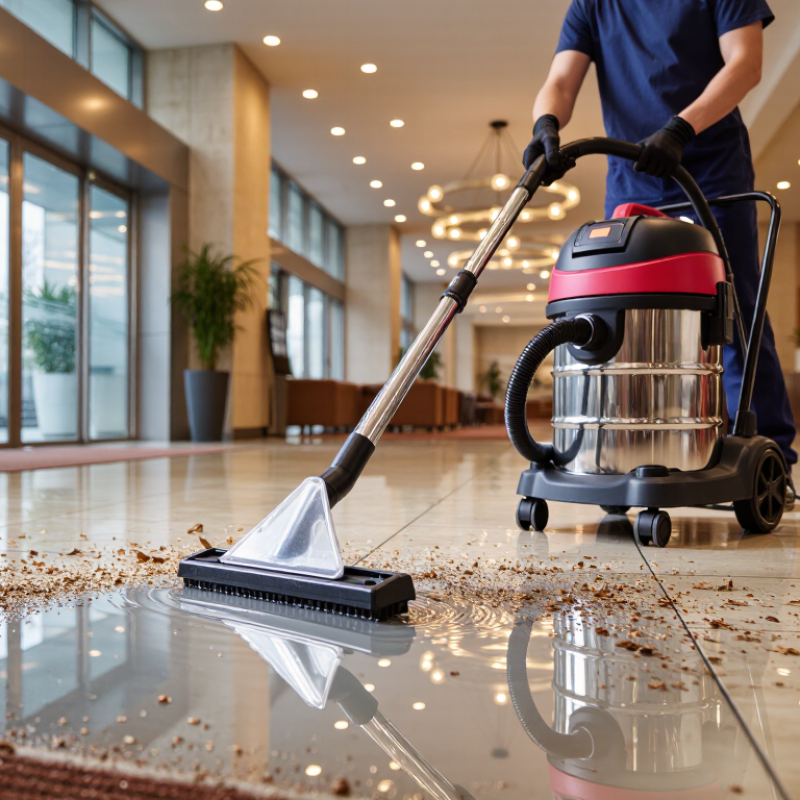
Define Business Water-Recovery Needs by Spill Volume and Soil Type
How to Choose the Best Water Vacuum for Your Business?
Spill volume should guide your first decision. A five-liter coffee spill needs a different machine from a flooded warehouse aisle. Measure the average incident, not the rare disaster. A compact recovery tank suits small offices and retail counters. Larger tanks reduce emptying trips in restaurants, workshops, and warehouses. Pump-out systems may help with repeated spills, but they require suitable drainage and trained operators.
The U.S. Environmental Protection Agency estimates that household leaks waste nearly one trillion gallons of water annually, showing how quickly small losses accumulate across facilities.
Soil type matters just as much. Clear water mainly requires strong airflow, efficient recovery, and a reliable squeegee. Muddy water needs wider hoses and filters that resist clogging. Grease demands chemical-resistant parts and a recovery system that is easy to clean. Carpet soil may include fibers, sand, and embedded grit.
Do not judge performance by suction alone. Test recovery speed on the actual floor surface. That detail is often missed.
The IICRC S500 standard distinguishes clean, gray, and black water conditions. Contaminated recovery needs controlled procedures, protective equipment, and proper disposal. It should not be treated like ordinary floor cleaning.
Liberty Mutual’s 2023 Workplace Safety Index placed same-level falls among the costliest workplace injuries, reinforcing the need for fast moisture removal.
Some specifications look impressive on paper. Field testing can still prove disappointing. Check tank capacity, hose reach, filter access, noise, and operator fatigue before purchasing.
Compare Suction Power Using Airflow, Sealed Lift, and Tank Capacity
How to Choose the Best Water Vacuum for Your Business?
Choosing a water vacuum depends on the worksite, not just the highest advertised number. I compare airflow, sealed lift, and tank capacity during realistic cleaning tasks.
Airflow, measured in cubic feet per minute, shows how quickly the vacuum moves water and debris. Higher airflow can clear a wide floor efficiently.
However, airflow may drop when the hose bends or the filter becomes dirty.
Sealed lift measures suction strength under restricted conditions. It matters when lifting water from carpets, drains, or uneven flooring. Strong sealed lift helps maintain pickup when resistance increases.
Both measurements matter. Neither tells the whole story.
Tank capacity affects work time between emptying cycles. A larger tank can improve productivity, but it also adds weight and may reduce maneuverability.
Usable capacity is often lower than the listed volume because shutoff systems need space.
Watch the foam.
My early comparisons were too simple.
I focused on suction numbers and overlooked hose diameter. That mistake changed results in real cleaning areas.
For reliable evaluation, test each vacuum with the same hose, filter condition, and water depth. Record pickup speed, noise, handling effort, and recovery time.
A balanced unit often performs better than one with extreme suction.
Maintenance also changes performance. Clean filters, sealed connections, and an unclogged float system help preserve consistent airflow during long shifts.
Assess Filtration: HEPA Captures 99.97% of Particles at 0.3 Microns
Filtration should be checked before motor power or tank capacity. A water vacuum may collect liquid efficiently, yet still release fine particles through its exhaust.
Look for a sealed filtration path, not only a HEPA label. Gaps around the lid, hose, or filter frame can reduce real-world protection. In a workshop, imagine fine dust settling on a wet floor, then becoming airborne when the tank is emptied. The filter must manage that risk without restricting airflow too severely. ASHRAE guidance notes that filter efficiency and system airflow must be considered together.
Wet operation needs extra attention. Some filters are not designed for direct liquid contact. A washable pre-filter can help protect the HEPA stage, but it requires regular cleaning and complete drying. Inspect the filter after each demanding shift. Replace damaged seals immediately. The 99.97% figure is a laboratory rating, not a permanent guarantee. I would also measure airflow during maintenance, because a clogged filter may look clean while performance quietly declines.
Verify Safety Against IEC 60335-2-69 and Required Workplace Standards
When choosing a water vacuum for business use, treat IEC 60335-2-69 as a verification point, not a marketing phrase. This standard addresses safety requirements for wet and dry vacuum cleaners used in industrial and commercial environments. Ask for the exact standard edition, test documentation, and scope of evaluation. A simple “compliant” statement is not enough.
Inspect the machine closely. Check whether the liquid shutoff works before water reaches the motor. Examine cable insulation, grounding arrangements, plug protection, and the separation between electrical parts and collected liquid. Look for clear capacity markings, stable wheels, and a hose that will not collapse under suction. Small details matter. Test the emergency stop, if fitted, in a controlled area.
Workplace rules may require electrical inspections, residual-current protection, noise controls, operator training, and documented maintenance. Requirements can differ between countries, buildings, and industries. Confirm them with a qualified safety professional or the site’s responsible person. Do not assume a product tested under IEC 60335-2-69 automatically satisfies every local workplace rule. That assumption is risky.
In daily use, keep inspection records and remove damaged equipment immediately. Wet floors can create a second hazard. Workers may also need suitable footwear and protective equipment. I have seen purchasing decisions focus too heavily on suction power. That is an easy mistake. A quieter, safer machine with dependable shutdown protection may serve the business better. Recheck the choice after real operators use it for a week. Their feedback often reveals problems missed during a showroom demonstration.
Calculate Total Cost Through Energy Use, Downtime, Maintenance, and Warranty
Choosing a water vacuum for business requires more than checking suction power. On a busy floor, the cheapest unit can become expensive. I have seen operators compare purchase prices while ignoring energy meters and lost production time. A practical calculation starts with five-year total cost. Record purchase price, electricity, labor, repairs, downtime, and warranty coverage. Keep assumptions visible. They may be wrong.
Estimate energy use from motor kilowatts, daily operating hours, working days, and local electricity rates. A 2.2-kilowatt motor running six hours daily uses 13.2 kilowatt-hours per day. Multiply that figure by your tariff and annual schedule. Do not trust brochure figures alone. Measure actual loading during wet recovery. A clogged filter or long hose can raise consumption and slow collection. Small losses repeat every shift.
Downtime deserves a clear hourly value. Add delayed cleaning, idle staff, rescheduled work, and possible customer disruption. Maintenance costs include filters, seals, hoses, disposal bags, inspections, and technician travel. Ask how often parts need replacement. Warranty terms matter when water enters sensitive components. Check response times, exclusions, labor coverage, and transport responsibility. A longer warranty is not automatically better. I would score service reliability separately, because an inexpensive repair is useless if the machine waits ten days. Leave room for uncertainty, and update the spreadsheet after three months of real use.
How to Choose the Best Water Vacuum for Your Business?
Estimated annual ownership cost by major cost driver, including energy use, downtime, maintenance, and warranty exposure.
The model assumes 1,000 operating hours per year, an electricity rate of $0.15 per kWh, and a downtime impact of $75 per hour. The efficient commercial model has the lowest projected annual cost because reduced downtime and energy consumption offset its purchase-related service costs. Actual results vary with workload, operating environment, service rates, and local electricity prices.
Related Posts
-
How to Find the Best Wet Dry Vacuum Manufacturer for Your Needs and Compare Options
-

How to Choose the Right Wet Dry Vacuum Cleaner to Maximize Cleaning Efficiency
-
The Ultimate Guide to Choosing the Best Wet Dry Vacuum Cleaner for Your Home and Beyond
-
How to Choose the Best Wet Dry Vacuum for Your Cleaning Needs
-
2026 Top Wet Dry Vacuum Cleaner Models You Should Consider?
-
Why Choose a Wet Dry Vacuum for Commercial Cleaning?