Top Stainless Steel Clamps Manufacturers for Global Buyers?
Choosing a reliable Stainless Steel Clamps manufacturer involves more than comparing prices or browsing product photos. Buyers need to know whether a supplier can match the clamp to the application, operating environment, and required dimensions. A pipe support exposed to moisture, for example, may need different material and finish considerations than a clamp used indoors. Small details matter. Ask about available steel grades, thickness tolerances, surface finishing, load data, and inspection records. Clear answers make supplier comparisons more useful.
This guide reviews manufacturers with global buyers in mind, focusing on product range, customization, quality controls, communication, and export experience. It also highlights practical questions to ask before requesting a quotation, such as whether samples are available and how production changes are documented. Claims should be checked against current certificates and product specifications, not accepted on appearance alone. No shortlist is perfect. A supplier that suits a large distributor may not fit a small project with unusual dimensions or a tight delivery window. Use the profiles as a starting point, then confirm requirements directly with each manufacturer. Even careful research can miss a detail; a short technical discussion often reveals what a catalogue cannot.
Types and Applications of Stainless Steel Clamps
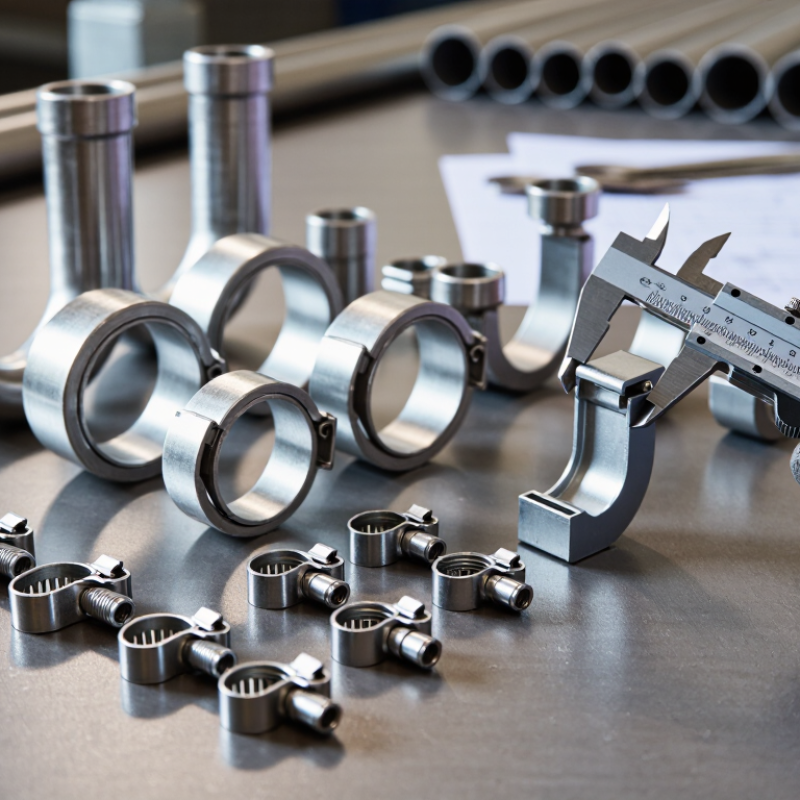
Stainless steel clamps secure hoses, pipes, and cable assemblies exposed to vibration, moisture, and temperature changes. Their design affects pressure distribution and serviceability. Worm-drive clamps use a slotted band and screw, making them adjustable for pump hoses, irrigation lines, and light-duty ducting. T-bolt clamps provide firmer, more even compression on larger hoses, such as those used in engine cooling and industrial air systems. Constant-tension clamps can accommodate some hose expansion as temperatures change, but they cannot compensate for incorrect sizing. V-band clamps join flanged components, while cushioned P-clamps support tubing or cables and reduce rubbing against nearby surfaces.
Fit matters.
Applications call for more than a quick check of the clamp’s material label. In washdown areas or coastal equipment, corrosion resistance depends on alloy grade, surface condition, and exposure to cleaning chemicals. Compare band width, fastener strength, hose material, and operating pressure before choosing a type. A clamp that feels secure by hand may still loosen or leak after heat cycling and vibration.
Check the details.
During maintenance, look for uneven seating, sharp edges, and early signs of corrosion.
The right choice can be less obvious than it seems.
How to Evaluate Stainless Steel Clamp Manufacturers
Evaluating a stainless steel clamp manufacturer starts with the actual application: hose diameter, operating pressure, vibration, and exposure to salt or chemicals. Ask which steel grade is used, and request material certificates tied to production batches. The World Stainless Association’s Stainless Steel in Figures 2024 reports 58.4 million tonnes of global stainless steel melt-shop production in 2023. That shows the scale of the material supply base, not the quality of any clamp. Keep that distinction clear.
Look beyond a polished catalogue. Request dimensional tolerances, tightening-torque results, and corrosion-test conditions. For marine or chemical environments, confirm whether the selected grade and finish suit the specific exposure; “stainless” does not mean rust-proof. Ask for samples and inspect the band edges, screw engagement, and housing alignment. Small burrs matter. A certificate alone is reassuring, but not enough.
Check whether the manufacturer can trace a finished clamp back to its material batch and production records. Review how it handles failed tests, design changes, and inconsistent dimensions. If salt-spray data is offered, ask which method was used and how the result relates to real service conditions; lab hours do not translate neatly into years outdoors. I would still test a sample on the intended hose. Paperwork can miss a poor fit.
Top Stainless Steel Clamps Manufacturers for Global Buyers? - How to Evaluate Stainless Steel Clamp Manufacturers
| Evaluation Dimension | What to Assess | Evidence to Request | Buyer’s Evaluation Check |
|---|---|---|---|
| Product and application fit | Confirm the clamp type, size range, connection style, and intended use, such as hose retention, pipe support, or cable management. | Product drawings, dimensional data, installation instructions, and a written application or operating-condition review. | Check that the proposed clamp matches the hose or pipe outside diameter, installation space, and service conditions. Do not assume one design suits every application. |
| Stainless steel grade and traceability | Verify the specified stainless steel grade for each component, including the band, housing, and screw where relevant. | Material test certificates, purchase specifications, and traceability records linking material batches to finished products. EN 10204 Type 3.1 inspection documents may be requested where applicable. | Confirm that the certificate identifies the material and heat or batch reference. Check that the grade meets the required corrosion and service conditions; “stainless steel” alone is not a complete specification. |
| Applicable standards | Determine whether a relevant product standard or customer specification applies to the clamp design and intended use. | Declaration of conformity, test reports, and a clear statement of the standard’s edition and product scope. | For applicable worm-drive hose clamps, ask whether the product is designed or tested to the relevant parts of DIN 3017. Verify scope and requirements rather than relying on a standards reference alone. |
| Testing and performance claims | Review claims about tightening torque, holding performance, vibration resistance, temperature range, or corrosion resistance. | Test methods, sample details, acceptance criteria, results, and reports from qualified laboratories where appropriate. | Compare results only when the test method, clamp size, materials, and test conditions are comparable. Torque and pressure limits are product- and application-specific, not universal values. |
| Corrosion suitability | Assess the complete clamp assembly against the expected exposure, including moisture, salt, chemicals, cleaning agents, and temperature. | Material specifications and, if relevant, corrosion-test reports identifying the test method, duration, and evaluation criteria. | Use tests such as those conducted under ISO 9227 as comparative evidence only. Salt-spray results do not by themselves predict service life in every real-world environment. |
| Quality management and inspection | Evaluate manufacturing controls, incoming material checks, in-process inspection, final inspection, and handling of nonconforming products. | Current quality-management-system certificate, inspection plan, sample inspection records, and corrective-action process. | Check certificate validity and scope. ISO 9001 certification indicates a quality-management system; it does not certify that every individual clamp meets a particular performance requirement. |
| Production capacity and consistency | Assess the manufacturer’s ability to produce the required quantities, sizes, and repeat orders with consistent specifications. | Production lead-time estimates, capacity information, process-control records, and samples from representative production lots. | Confirm whether quoted lead times include tooling, testing, packaging, and shipping. Agree in writing on change notification and approval requirements. |
| Sampling and product approval | Establish a clear process for prototype review, pre-production samples, and approval before volume orders. | Sample inspection report, approved drawing, agreed specification, and a documented sample-retention or reference process. | Measure critical dimensions and verify materials and assembly against the approved documents before authorizing production. |
| Export readiness and packaging | Review export documentation, product identification, packaging protection, and labeling requirements for the destination market. | Sample packing list, product labels, packaging specification, and confirmation of documentation responsibilities. | Check packaging suitability for storage and transport, as well as any buyer-specific marking, language, or traceability needs. |
| Commercial terms and after-sales support | Compare quotation scope, minimum order quantities, payment terms, warranty conditions, and response procedures for quality issues. | Written quotation, sales terms, warranty policy, and a documented complaint and corrective-action process. | Ensure the quotation identifies the exact material, dimensions, finish, quantity, packaging, delivery terms, and any testing or certification costs. |
Evaluation note: Request evidence for the specific clamp model and production lot being considered. Certifications, standards references, and test results should be checked for scope, validity, and relevance to the buyer’s application.
Leading Stainless Steel Clamp Manufacturers by Region
Regional strengths can help buyers narrow a supplier search, but they do not guarantee product quality. European manufacturers often serve industrial markets needing consistent dimensions, documented material grades, and precise finishing. North American suppliers may offer application support and custom configurations, especially for equipment maintenance and fluid systems. East Asian production hubs can provide broad product ranges and substantial manufacturing capacity. India and Southeast Asia are also developing options for buyers seeking varied production volumes. These are general patterns, not fixed rules. Fit matters.
Compare the clamp, not just the region. Check whether the steel grade is stated clearly, such as 304 or 316, and confirm band width, thickness, and closure design. Ask for sample parts and inspect the screw engagement, burrs, and smoothness of the band edge. For corrosive environments, request relevant test information and clarify how results apply to the intended use. A polished surface alone proves little. I would also verify batch traceability, packaging, and lead-time commitments before placing a large order. Supplier claims can be incomplete, and regional assumptions can mislead; a small trial order may reveal issues that a catalog will not.
Comparing Product Range, Quality, and Certifications
For global buyers, comparing stainless steel clamp manufacturers starts with the product range. Check whether a supplier offers different diameters, band widths, and fastening styles for your actual installation. A broad catalogue can help, but range alone proves little. Fit matters. Ask for dimensional drawings and sample parts, especially when clamps must sit around a hose with a fixed outside diameter. Small differences can cause leaks or uneven pressure.
Quality needs evidence beyond a polished product photo. Review material specifications, surface finish, edge smoothness, and tightening consistency. A sharp band edge may damage a hose; a weak screw may strip during installation. Ask how production batches are inspected and whether test records are available. Independent inspection can add confidence for larger orders. Still, one sample cannot represent every batch.
Certifications should match the buyer’s application and market requirements. Request current certificates, confirm their scope, and check whether they cover the relevant facility and product type. A certificate logo is not enough. Traceability records and clear material documentation are useful signs of a controlled process. I would also compare lead times, packaging, and response quality; these details are easy to overlook. No supplier is perfect, and a neat document set does not guarantee consistent performance in the field.
Key Considerations for Global Sourcing and Supplier Selection
Global sourcing of stainless steel clamps begins with a precise application brief. Small differences in band thickness, edge finish, and closure design can affect fit and service life. Specify pipe diameter, pressure, vibration, temperature, moisture, and exposure to salt or cleaning chemicals. Without these details, suppliers may quote different products under the same description. That is a costly mismatch.
Ask for the stainless steel grade, material test documents, dimensional tolerances, and inspection records. In corrosive settings, confirm that the grade suits the actual environment; “stainless” alone is no performance guarantee. Request samples made through the intended production process, not just polished display pieces. Measure band width and thickness, and check fastening consistency across several units. A sample can pass while a production batch drifts. It happens.
Compare more than unit price. Review minimum order quantities, tooling charges, packaging, shipping terms, capacity, and realistic lead times. Ask how defects are recorded and corrected, and whether batch identification is maintained. A factory audit or independent inspection may be worthwhile when order volumes justify the cost. Communication matters too: vague answers about tolerances or material traceability need follow-up. Supplier selection is rarely perfect; document assumptions and reassess them after the first delivery.
Stainless Steel Clamp Sourcing: Chromium Ranges by Grade
Specified chromium content in common stainless steel grades (weight %)
Chromium content is one factor to verify when selecting clamp material for corrosion resistance. Check the applicable product specification and request material test certificates to confirm the supplied grade. Ranges shown are based on ASTM A240/A240M composition limits; requirements may vary by specification and product form.