How to Choose the Right Agricultural Bearing?
Choosing an Agricultural Bearing means matching a component to real field conditions, not just selecting a familiar size. A bearing on a seed drill may face dust, vibration, and long hours at steady speed. A wheel hub encounters changing loads, moisture, and occasional impacts. These differences matter. They affect bearing type, internal clearance, seal design, lubrication, and expected service life.
Start with the machine manufacturer’s specifications, then check operating load, shaft speed, temperature, and mounting dimensions. Consider what the seal must keep out: fine soil, crop residue, wash water, or a mixture of all three. A well-sealed unit can help protect rolling surfaces, but no seal compensates for poor installation or neglected lubrication. Small details matter. Grease compatibility, alignment, and correct fit can influence performance as much as the bearing itself.
This guide explains how to compare common bearing arrangements and identify practical selection criteria. It also highlights questions worth asking suppliers, including material, sealing, maintenance needs, and support for replacement parts. Product descriptions can be useful, but they rarely capture every field condition. A bearing that works well in one implement may not suit another, even when dimensions match. Not always. Check the equipment manual and consult a qualified bearing specialist when loads, fit, or operating conditions are uncertain. Careful selection cannot prevent every failure, but it can reduce avoidable downtime during demanding seasons.
Assess the Machine’s Loads, Speed, and Field Conditions
Start by measuring radial and axial loads, not guessing from shaft size. A cultivator hub may face steady weight, sudden stone impacts, and changing loads during turns. Record the load cycle and peak shocks, then compare them with the bearing’s dynamic load rating. ISO 281:2007 defines basic L10 life at 90% reliability. Its calculation uses dynamic load rating C and equivalent dynamic load P: for ball bearings, L10 = (C/P)3 million revolutions; for roller bearings, the exponent is 10/3. This is a calculated baseline, not a guarantee in dirty field service.
Check operating speed across the full work cycle, including brief high-speed runs and slow, heavily loaded turns. Heat, lubricant choice, and sealing can limit practical speed. Then inspect the actual field conditions: dust around a disc harrow, water near a sprayer, or crop residue packed against a housing. Real fields are messy. Choose sealing and lubrication for those exposures, and leave room for temperature checks after installation. A bearing that fits on paper may still fail early if grit enters during service. I would recheck the load estimate, too; impact forces are easy to underestimate, especially when soil conditions change. Record operating hours, temperature, and any abnormal noise, then use those observations to refine the next selection.

Match Bearing Types to the Application’s Requirements
How to Choose the Right Agricultural Bearing?
Match bearing types to the application’s requirements, not just the shaft size. USDA NASS counted about 1.9 million U.S. farms in its 2022 Census of Agriculture, reflecting varied equipment and operating conditions. A tractor wheel hub faces road vibration, while a cultivator shaft meets soil shock and dust. Different jobs need different bearing features.
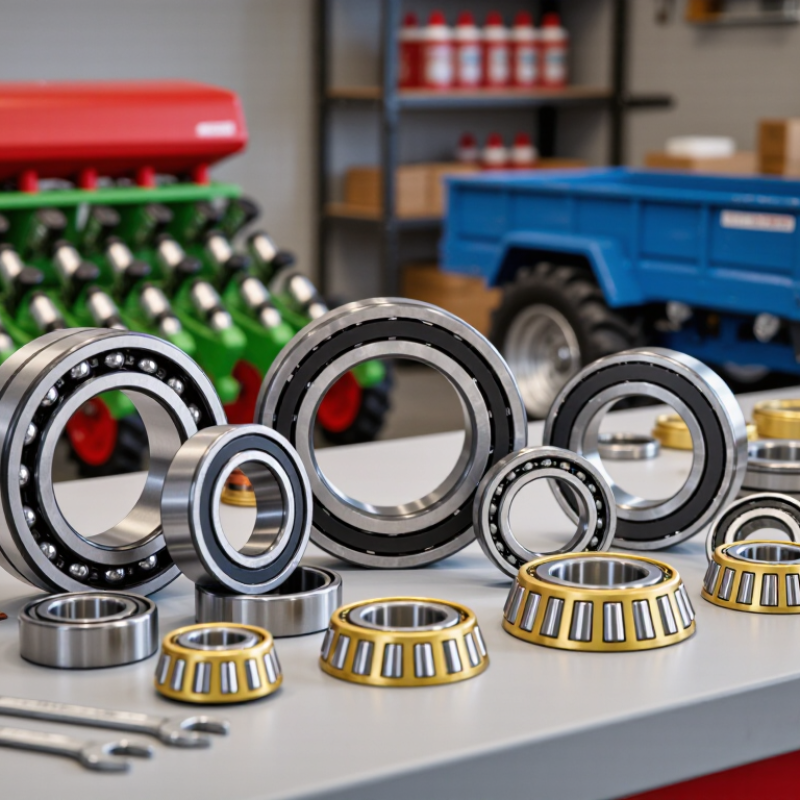
Deep-groove ball bearings suit many moderate-load, higher-speed applications. Tapered roller bearings handle combined radial and axial loads, making them common choices for wheel hubs. Spherical roller bearings can tolerate misalignment and heavy shock, but they are not automatically the best option. Dust gets everywhere. Check sealing, relubrication access, operating speed, and load peaks before selecting a type. ISO 281:2007 defines basic rating life, L10, as the life reached by 90% of a sufficiently large group of identical bearings under stated conditions. That rating is not a field-life guarantee; contamination, poor fits, and impact loads can shorten service. A tidy load estimate may still miss the hardest moment, such as a wheel striking a rut. Revisit assumptions against actual maintenance records and operating conditions.
How to Choose the Right Agricultural Bearing? — Match Bearing Types to the Application’s Requirements
| Bearing Type | Typical Agricultural Applications | Load and Alignment Characteristics | Why It May Be Suitable | Selection Considerations |
|---|---|---|---|---|
| Deep-Groove Ball Bearing | Small electric motors, fans, pumps, and auxiliary equipment | Primarily supports radial loads and can also accommodate moderate axial loads in both directions. Generally suited to higher speeds. | Offers low friction and a simple, compact design for applications with steady operation and relatively well-aligned shafts. | Check the actual load, speed, sealing, and contamination conditions. It is not usually the first choice for severe misalignment or very heavy shock loads. |
| Spherical Roller Bearing | Heavy-duty conveyor rollers, large harvesting machinery, and equipment with flexible or deflecting shafts | Designed for heavy radial loads and can support axial loads, depending on bearing design. Accommodates angular misalignment. | Useful where heavy loads, shaft deflection, or housing misalignment are expected. | Confirm the required axial-load direction and magnitude, operating speed, lubrication method, and available space. Correct installation and lubrication are important. |
| Tapered Roller Bearing | Trailer and implement wheel hubs, gearboxes, and other assemblies with combined loads | Supports combined radial and axial loads. A single bearing generally carries axial load in one direction; paired arrangements can support axial loads in both directions. | Suitable for applications where wheel or shaft loads act both across and along the axis. | Paired bearings often require correct adjustment or preload and suitable lubrication. Follow the equipment design and manufacturer’s installation specifications. |
| Needle Roller Bearing | Compact gearboxes, transmissions, and pivot points with limited radial space | Provides relatively high radial-load capacity for its small cross-section. Standard needle roller arrangements generally do not accommodate angular misalignment and do not carry axial loads unless combined with suitable components. | Useful when radial space is restricted but a rolling bearing is needed to support radial load. | Check shaft and housing raceway requirements, lubrication access, alignment, and whether separate axial guidance is needed. |
| Mounted Insert Bearing | Conveyors, augers, feed-handling equipment, and agricultural machinery shafts | Typically uses an insert bearing in a housing. Many designs accommodate some initial misalignment and are available with seals; load and speed capacity depend on the specific unit. | The housed assembly can simplify mounting and replacement in common support positions. | Choose the housing style, shaft-locking method, sealing arrangement, and lubrication provision to suit the installation and contamination exposure. Verify that the unit’s ratings meet the application. |
| Thrust Bearing | Vertical shafts, screw mechanisms, and assemblies where axial force is the primary load | Designed primarily for axial loads. Conventional thrust bearings are not intended to carry significant radial loads. | Provides a bearing arrangement for axial force when radial support is handled separately. | Identify the load direction, speed, lubrication, and any radial support requirements. Do not use a thrust bearing as a substitute for a radial-load bearing. |
Selection note: Bearing type alone does not determine suitability. Confirm load magnitude and direction, speed, shaft and housing fit, misalignment, shock, sealing, lubrication, temperature, and maintenance access against the equipment design and bearing ratings.
Compare Materials, Seals, and Lubrication Options
How to Choose the Right Agricultural Bearing?
Material, seal, and lubricant choices should match the machine’s actual working conditions. For example, a bearing near a wet field may need corrosion-resistant surfaces, while a dusty grain auger needs protection from fine particles. Hardened steel is common for load capacity, but it can corrode if moisture reaches unprotected surfaces. Stainless steel may help in damp settings, though it is not automatically the best choice for every load or budget. Check the bearing’s rated load and speed, not just its material.
Seals influence how well a bearing keeps out water, soil, and crop debris. Contact seals generally offer stronger contamination protection, but they can create more friction than non-contact shields. Lubrication matters just as much. Grease must suit the operating temperature and expected speed, and relubrication intervals should follow the equipment maker’s guidance. Too much grease can also cause heat buildup. Small details matter.
Tips: Look for packed dirt around the seal, unusual warmth, or a rough sound during operation. These clues do not prove the bearing has failed, but they deserve a closer inspection. Match the seal to the exposure, then confirm lubricant compatibility before changing products. Field conditions can be inconsistent, and a choice that works in one season may need reconsideration after a wet harvest.
Verify Dimensions, Fits, and Compatibility
Start with the bearing’s full designation, then confirm its bore, outside diameter, and width against the machine’s shaft and housing. Measure clean surfaces with a suitable caliper or micrometer; dirt and burrs can distort readings. A worn shaft can make the old bearing seem like the right reference. It is not. Check the equipment manual or a reliable dimensional table before ordering, especially when a suffix identifies a seal or clearance variation.
Fit matters as much as size. The inner ring may need a tighter fit on a rotating shaft, while the housing fit depends on load direction and operating conditions. Follow the bearing maker’s fit recommendations for the actual shaft material, load, and temperature. Too loose, and the ring may creep; too tight, and installation can reduce internal clearance. Small differences matter. Avoid forcing a bearing into place to test compatibility.
Then compare the bearing type and features with the application. Note rotational speed, radial and axial loads, and any shaft misalignment. On a dusty field machine, seals can help keep grit out, but confirm that their design suits the operating speed and heat. Check lubrication requirements and available space around the housing, too. If the measurements are close but not exact, pause and recheck the shaft and housing for wear. That extra check is easy to skip.
Evaluate Maintenance Needs and Service Life
When choosing an agricultural bearing, consider how often equipment can realistically be serviced. A bearing buried behind a guard may be harder to inspect than one beside an accessible grease point. Dust, moisture, crop residue, and pressure washing can all affect lubrication and seal performance. Dust changes everything. Match the bearing’s sealing and lubrication arrangement to the actual field conditions, not just the machine’s specification sheet.
Check the maintenance instructions for relubrication intervals, grease type, and signs of over-greasing. Too little lubricant can increase friction, while excess grease may attract debris or raise operating temperatures. During routine checks, listen for unusual noise and feel for changes in housing temperature, using safe inspection procedures. A simple record of operating hours, lubrication, and repairs can reveal patterns before a failure stops work.
Service life depends on load, speed, alignment, contamination, and maintenance quality. Ask whether the expected interval between inspections fits the farm’s working season and available labor. Still, estimates are only estimates. Real field conditions can be rougher than test conditions, and a bearing may wear sooner than expected. Allow time for inspection and replacement, especially before peak planting or harvest periods.