
How to Choose the Right Electric Flatbed Truck for Your Business

Choosing an Electric Flatbed starts with the work it must do each day, not the largest range figure in a brochure. Route length, payload, road conditions, and charging access all affect real-world performance. A crew carrying fencing panels across town has different needs from one moving equipment between rural sites. That difference can change the required battery capacity, deck dimensions, and payload rating. Small details count. Record typical loads, the longest regular route, and where the truck can charge overnight. Then compare those facts with the manufacturer’s specifications.

Check payload after accounting for the flatbed body, passengers, tools, and fitted accessories. Look closely at deck height, tie-down points, cab comfort, and how easily drivers can load bulky items. Ask the dealer about charging time, service support, warranty coverage, and parts availability. These are practical checks, not minor extras. A spreadsheet will not reveal every snag; winter temperatures, detours, or shared charging stations can disrupt tidy estimates. Your assumptions may need revisiting.

The right choice balances daily capability with purchase and operating costs. Compare models using your own duty cycle, and request clear information about usable range and charging requirements. If possible, arrange a demonstration with a representative load. This guide outlines the questions to ask before choosing, from matching truck specifications to evaluating charging plans and long-term support. No single model suits every business. A careful, evidence-based comparison can help you find a flatbed that fits the work without paying for capacity you rarely use.
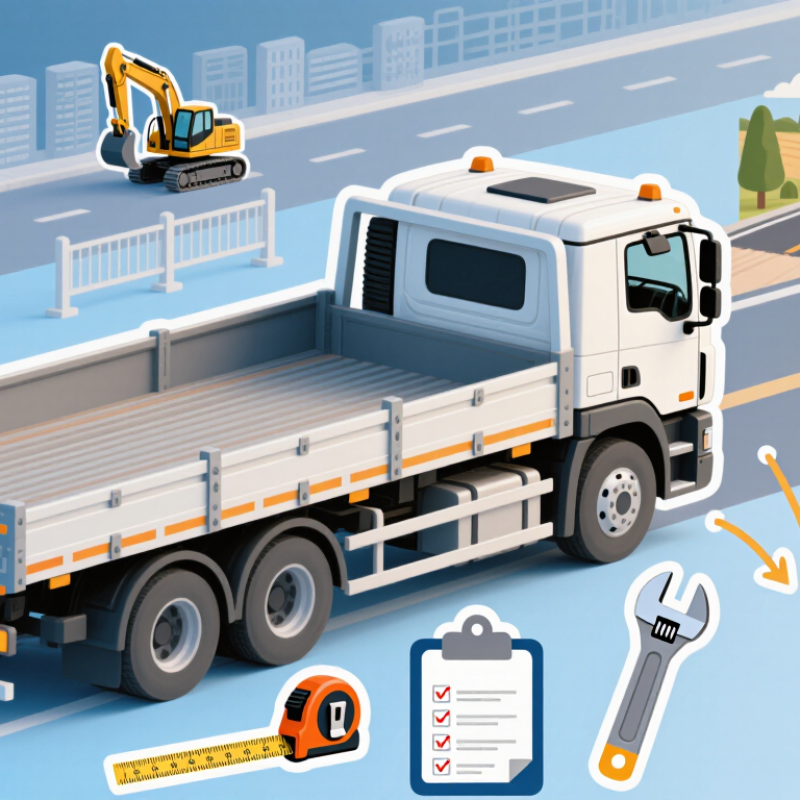
How to Choose the Right Electric Flatbed Truck for Your Business

Define Your Business’s Load, Route, and Daily Capacity Requirements

Start with the heaviest load the truck will carry on a normal workday. Compare it with the vehicle’s rated payload, including the bed, tools, and any load-securing equipment. A 900-kilogram load may fit by weight but not by length or width. Measure both. Leave a practical margin for unevenly packed goods and changing orders. The first estimate is often wrong.

Map the actual route, not just the distance between the depot and the customer. Note steep ramps, tight loading bays, rough pavement, and stop frequency. A truck that travels comfortably on flat roads may use more energy on hills or during repeated starts. Record a typical route over several days; one unusually quiet shift can distort the picture. Also check whether the truck can turn and reverse safely in your busiest delivery areas.

Estimate daily capacity by counting trips, loading time, unloading time, and breaks. For example, a route with six short stops may take longer than two longer deliveries, even over fewer kilometres. Compare expected energy use with the usable battery range, allowing room for weather, payload, and route variation. Charging access matters too: confirm where the truck can charge and how long it can remain there. Keep a simple log during a trial period. It will expose gaps in your assumptions, though the log itself may be incomplete at first.


Compare Payload, Flatbed Dimensions, Range, and Performance

How to Choose the Right Electric Flatbed Truck for Your Business

Compare payload, flatbed dimensions, range, and performance against the work you actually do. Payload capacity must cover the driver, passengers, tools, and typical cargo—not just the goods on the bed. Check the vehicle’s rated limits, then weigh a representative load if possible. A few heavy tools can change the calculation.

Measure your longest regular items and the loading space they need. A bed that is too short may require extra trips; an oversized one can make tight yards harder to navigate.

Range depends on more than the battery. Heavy loads, steep roads, cold weather, and frequent stops can reduce the distance available between charges. Track a normal route, including return travel and detours, and leave a practical reserve.

Check climbing ability and acceleration with a realistic load, especially if the truck uses ramps or travels on uneven sites. A spreadsheet can make the choice look settled; real routes are less tidy.

Tips: Measure cargo before comparing bed dimensions. Ask for usable range under load, not only an ideal estimate. If possible, test-drive a loaded vehicle on a route similar to your own. Keep notes; small details matter.

Assess Battery Options, Charging Access, and Downtime

A battery’s advertised range is only a starting point. Record your actual route, payload, stop frequency, and hours spent waiting with the truck powered on. A flatbed carrying dense materials may use energy differently from one making short, lightly loaded trips. Leave a practical reserve for detours, cold mornings, and unexpected loading delays. Not every workday repeats neatly.

Compare battery options by usable capacity, charging time, and how well they fit your duty cycle. Ask suppliers for data under loads and conditions similar to yours, not just ideal test results. Then run a representative route and track energy use across several shifts. One day can mislead. I would also note when the truck is genuinely available to charge: overnight at the depot, during a scheduled break, or between jobs. Check that the site’s electrical supply can support the planned charging equipment, and confirm who can move vehicles when charging spaces are limited. A missed charging window can disrupt the next shift. Estimate downtime in hours, including connection, charging, and any waiting for access, before deciding how much battery capacity your operation really needs.

Check Safety Features, Regulations, Service, and Warranty

Choosing an electric flatbed truck starts with the work it must do each day. List typical payloads, route distances, gradients, and hours between charging opportunities. A truck that feels steady on an empty yard may respond differently with a pallet near the rear edge. Check braking performance, seat belts, mirrors or cameras, warning signals, and load-restraint points. Test it loaded.

Regulations vary by location and vehicle configuration, so confirm requirements with the relevant local transport authority before ordering. Ask which vehicle ratings, lighting, driver qualifications, inspections, and road-use rules apply to your routes. Request written specifications and compliance documents, then compare them with your planned loads. A sales conversation alone is not enough. Keep a record of answers; small details can be forgotten once delivery is underway.

Service access matters when a truck supports daily operations. Ask how quickly technicians can respond, whether routine maintenance is available nearby, and how long common replacement parts may take. Read the warranty carefully, especially coverage for the battery, drive system, and charging equipment. Check exclusions, time limits, mileage limits, and who pays for transport during repairs. A neat warranty summary can still leave unclear gaps, so ask for examples in writing. That extra check may feel tedious, but downtime is real.

Compare Total Ownership Costs and Verify Your Shortlist in Practice

How to Choose the Right Electric Flatbed Truck for Your Business

Compare Total Ownership Costs and Verify Your Shortlist in Practice

A low purchase price can hide expensive charging upgrades, peak-demand fees, or lost work time. Compare each electric flatbed with your current truck over the same ownership period and annual mileage. Include financing, electricity, maintenance, tires, insurance, charger installation, and expected resale value. Then check whether the truck’s usable payload and range fit your actual routes, not just the specification sheet. Small details matter.

The International Energy Agency’s Global EV Outlook 2024 reports that battery pack prices fell 14% in 2023. That is useful context, not a promise that your next truck will cost less. Ask suppliers for written battery warranty terms and model your costs using local electricity rates. Test a loaded route, including stops, grades, and a full workday. Record energy use, charging time, and any missed jobs. A spreadsheet can still miss operational friction.

Tips: Run a short, representative pilot before committing. Photograph the load, note the weather, and measure the energy used after each shift. Compare results with your diesel truck’s fuel and downtime records. If a public charging stop or a slow loading bay disrupts the schedule, include that cost. I would not trust a shortlist built on ideal conditions alone.

How to Choose the Right Electric Flatbed Truck for Your Business - Compare Total Ownership Costs and Verify Your Shortlist in Practice
Generic vehicle class Typical business fit Planning payload range Practical route range to verify Illustrative purchase budget (USD) 5-year charging & installation budget (USD) 5-year energy cost (USD) 5-year maintenance budget (USD) 5-year insurance estimate (USD) Estimated resale value after 5 years (USD) Illustrative 5-year TCO (USD) Shortlist verification in practice
Light-duty flatbed Urban deliveries, service work, and lighter materials with frequent stops Approximately 1,000–2,000 lb; confirm the specific chassis, body, and axle ratings Plan around 100–140 miles per working day; verify with the actual payload, weather, and route $85,000 $4,000 $9,750 $12,000 $30,000 $21,250 $119,500 Load the truck to typical working weight, then drive a representative stop-and-go route and confirm end-of-day battery reserve.
Medium-duty flatbed Regional work, heavier equipment, and mixed urban/highway routes Approximately 3,000–6,000 lb; verify payload after fitting the flatbed and accessories Plan around 80–120 miles per working day; test the longest regular route with a realistic load $110,000 $8,000 $12,750 $15,000 $37,500 $22,000 $161,250 Check loaded range, charging time during the available depot window, and whether the site has enough electrical capacity.
Heavy-duty flatbed High-payload operations, construction support, and demanding daily duty cycles Approximately 6,000–10,000 lb or more, depending on chassis and configuration; verify legal payload and axle limits Plan around 60–100 miles per working day; include hills, highway speed, and auxiliary loads in the test $140,000 $12,000 $16,500 $20,000 $45,000 $25,200 $208,300 Conduct a loaded route trial and confirm payload, grade performance, charging access, and service support before ordering.
Planning assumptions: Illustrative estimates, not market quotations or vehicle specifications. TCO covers five years and 100,000 miles (20,000 miles per year). Energy is modeled at $0.15/kWh using 0.65, 0.85, and 1.10 kWh per mile respectively, including a simplified allowance for charging losses. TCO = purchase budget + charging equipment and installation + energy + maintenance + insurance − estimated resale value. Estimates exclude financing, taxes, incentives, downtime, and the cost of any required electrical upgrades beyond the stated charging budget. Obtain current written vehicle, insurance, energy, and charging quotes; verify payload from the completed vehicle’s certification and test the shortlisted configuration on your own routes.
Go to Top