
China Top 10 L Angle Steel Manufacturers for Buyers

Choosing an L Angle supplier in China is not just a price comparison. Buyers need to examine steel grade, dimensions, production consistency, and delivery capability. An angle that looks correct on a drawing may still vary in thickness, straightness, or finish. Those small differences matter when sections meet on site.

Steel sourcing specialist Daniel Chen puts the buyer’s challenge this way: “A dependable L Angle supplier proves consistency in the details, not just the quotation.” Buyers should treat this as a practical principle, not a substitute for documented evidence. Request current mill test certificates, confirm the applicable grade and dimensional tolerances, and ask how the manufacturer handles inspection and packing. A clear response is useful. So is a factory audit, where appropriate.

This guide to China’s top 10 L Angle manufacturers is intended to help buyers compare suppliers with care. It considers product range, manufacturing capability, quality controls, export experience, and communication. The ranking should be a starting point, not a final verdict. Supplier performance can vary by order, specification, and production schedule. That is worth remembering.

Before requesting quotations, prepare the details: leg dimensions, thickness, length, grade, finish, quantity, and destination. A precise inquiry makes supplier responses easier to compare. Check whether quoted terms include testing, protective wrapping, and loading arrangements. A low price can leave important questions unanswered. Even a well-presented company profile cannot replace order-specific checks. Use the list to narrow your options, then verify the evidence behind each supplier’s claims.
China Top 10 L Angle Steel Manufacturers for Buyers

What L Angle Steel Is and How It Is Made

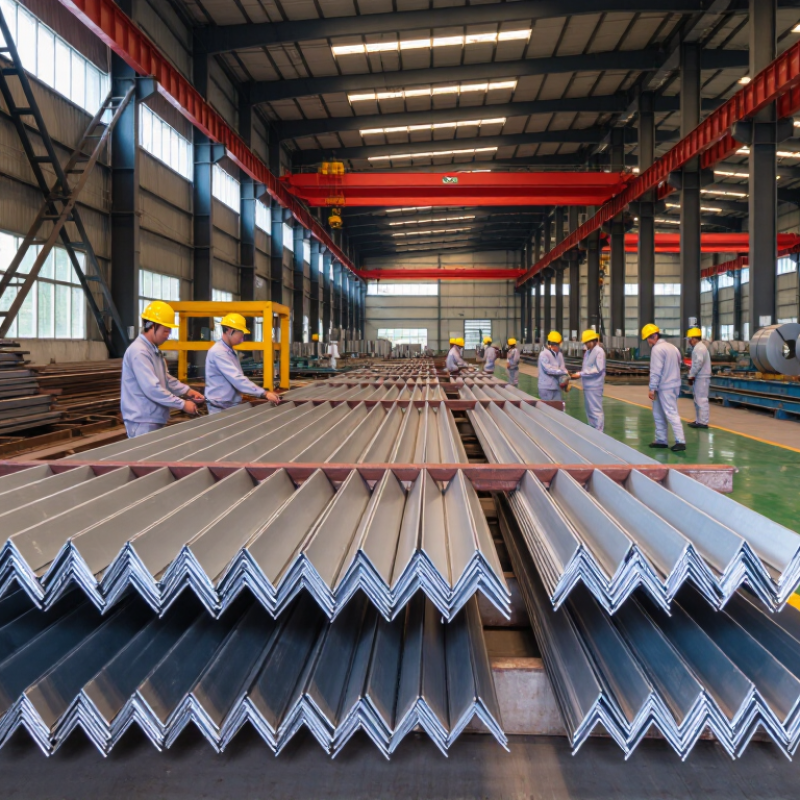
L angle steel is a structural section with two legs joined at a right angle. The legs may be equal or different in length, depending on the design. You can see the profile clearly at a cut end: two flat sides meet at the corner. It is used in frames, supports, and bracing where a compact, rigid shape is useful. Small dimensional differences matter.

Most structural L angles are made by hot rolling. Steel billets are heated until they can be shaped, then passed through a series of grooved rollers. Each pass gradually forms the legs and inside corner. The section is cooled, straightened, and cut to length. Some lighter profiles are formed from steel strip at room temperature, so the production route depends on thickness and application.

At a mill, quality checks can include leg dimensions, thickness, straightness, and surface condition. Chemical analysis and mechanical tests help confirm the steel’s specified properties. A buyer should check tolerances as well as nominal size; a 50 mm leg does not tell the whole story. In practice, the process sounds tidier on paper than it looks on a busy production floor. Not every surface mark means a defect, but visible cracks or severe bends deserve attention.


How to Evaluate China-Based L Angle Steel Manufacturers

When evaluating China-based L angle steel manufacturers, judge production scale and product control separately. The World Steel Association’s World Steel in Figures 2024 reports that China produced 1,019.1 million tonnes of crude steel in 2023, about 54% of global output. That scale offers supply options, but it does not prove a particular mill can hold consistent dimensions. Ask for current specifications covering leg length, thickness, straightness, and length tolerance.

Request a mill test certificate for the actual heat, not just a sample document. Check that its heat number matches the bundle tags and that chemistry and mechanical results meet your purchase specification. For galvanized angles, clarify coating mass and measurement method. A small trial order can reveal practical issues: mixed lengths, rough cut ends, or packaging that shifts during unloading. A polished brochure is not evidence. I would still verify claims independently; it takes time, and checks can miss things.

Tips: Compare a physical sample with the drawing using calipers and a straightedge. Agree on inspection points before production, then use an independent inspector if the order is large or critical. Keep photos, test records, and approved tolerances with the purchase file.

China Top 10 L Angle Steel Manufacturers for Buyers - How to Evaluate China-Based L Angle Steel Manufacturers

No. Evaluation Factor What Buyers Should Check Evidence to Request Priority
1 Product Standards Confirm that the proposed angle steel complies with the standard and edition specified in the purchase contract. Common references include GB/T 706 for hot-rolled section dimensions, EN 10056 for structural steel equal and unequal angles, and ASTM A36 for carbon structural steel material requirements. Written standard and edition, product specification, and a sample inspection or test report. Check that the standard applies to the requested product and properties. Critical
2 Dimensions and Tolerances Compare leg lengths, thickness, length, and permitted tolerances against the drawing or applicable product standard. Specify equal-leg or unequal-leg angles and whether cut-to-length pieces are required. Dimensioned product list, technical drawing, and inspection records showing measured values and the applicable tolerance limits. Critical
3 Steel Grade and Chemistry Match the requested grade and chemical composition to the relevant material specification. Do not assume that similar grade names from different standards are interchangeable. Mill test certificate (MTC) identifying the heat number, grade, chemical analysis, and referenced standard. Verify traceability between the certificate and delivered material. Critical
4 Mechanical Properties Check the specified tensile strength, yield strength, elongation, and any required impact properties against the contract and material standard. Test results linked to the heat or batch, with test methods and units stated. Request independent testing if required by the project or purchase terms. Critical
5 Manufacturing Capability Establish whether the supplier manufactures the product or trades it, and confirm that its available production route can meet the requested sizes, quantities, and delivery schedule. Written description of the production and quality-control process, available size range, production plan, and clarification of any subcontracted operations. High
6 Quality Management Review how the supplier controls incoming materials, production checks, final inspection, nonconformities, and corrective actions. ISO 9001 is a quality-management-system standard; certification alone does not prove that a particular shipment conforms. Current certificate details where applicable, certificate scope and validity, inspection plan, sample quality records, and the process for handling nonconforming products. High
7 Surface Condition and Finish Agree on acceptable surface condition, including rust, scale, dents, and edge damage. For coated or galvanized angles, define the coating requirements separately from the base-steel specification. Written acceptance criteria, representative photos or samples, coating specification where applicable, and pre-shipment inspection findings. High
8 Packaging and Identification Check that bundles can be handled and transported safely and that product identification remains readable through shipment and receiving inspection. Packaging plan stating bundle size, strapping or protection, marking details, and the information shown on bundle tags, such as size, grade, quantity, and heat or batch reference. Medium
9 Delivery and Export Readiness Confirm the production lead time, shipment terms, loading plan, port or delivery point, and responsibility for freight, insurance, and export documentation under the agreed Incoterms® rule. Quotation with a named Incoterms® rule and place, production and shipping schedule, packing list format, and a list of documents supplied for the destination market. High
10 Commercial Terms and Risk Controls Compare the total landed cost rather than unit price alone. Clarify payment milestones, quantity tolerances, inspection rights, claims procedure, and remedies for specification or delivery issues. Itemized quotation, signed technical specification, purchase contract, agreed inspection and claim terms, and a defined process for resolving discrepancies. High

Profiles of 10 Leading L Angle Steel Manufacturers in China

China’s L-angle steel suppliers serve construction, machinery, infrastructure, and fabrication markets. The World Steel Association reported that China produced about 1,005 million tonnes of crude steel in 2024, roughly 53% of global output. Scale matters, but it does not prove that every mill offers consistent angle dimensions or dependable delivery. Buyers comparing ten manufacturers should examine each profile for rolling capacity, steel grades, size range, inspection methods, and export experience.

A useful comparison separates integrated producers from specialized rolling plants. The former may offer broader sourcing and processing options; the latter may focus on selected sections, shorter production runs, or tailored specifications. Check mill test certificates, dimensional tolerances, coating options, packing details, and lead times against the project’s requirements. Ask how the supplier handles out-of-tolerance pieces. Small deviations matter.

Profiles should also distinguish verified facts from sales claims. Compare stated monthly capacity with recent shipment records, and request sample inspection documents where available. The World Steel Association’s production statistics describe national output, not the performance of individual factories. One limitation remains: public company data can be uneven, so a polished profile is not a substitute for independent verification.

China L Angle Steel: Theoretical Mass by Section Size

A size-based reference for buyers comparing common equal-angle sections. Values are calculated estimates, not manufacturer-specific product data.

Estimated mass uses the sharp-corner area formula A = t(a + b − t) and a steel density of 7,850 kg/m³. Actual standard-table weights can vary because of corner radii and product tolerances.

Comparing Product Range, Quality, and Production Capacity

Buyers comparing ten Chinese L-angle steel manufacturers should look beyond catalog breadth. A useful range includes equal- and unequal-leg sections, varied thicknesses, standard lengths, and suitable steel grades. Check whether cutting, drilling, or surface treatment is available in-house. These details matter. Request dimensional tolerances and material test certificates linked to the actual production batch, not a generic sample. For humid or coastal projects, confirm the coating type and measured thickness; a finish name alone says little about durability.

Quality also depends on consistent production and inspection. Ask how often dimensions are checked and how nonconforming pieces are handled. Production capacity needs context: quoted monthly tonnage may cover several product types or facilities. Ask about rolling lines, recent output, and realistic lead times for your section sizes. A factory may have impressive capacity but limited room during peak orders. Consider a trial order and compare delivered dimensions, surface condition, and paperwork. Small inconsistencies are worth discussing, not ignoring.

How Buyers Can Verify Suppliers and Plan Procurement

For buyers comparing China’s L angle steel suppliers, verification should begin with the product, not the catalogue. Request a mill test certificate showing grade, heat number, chemical composition, and mechanical properties. Match the heat number to bundle tags and shipping documents. Check leg width, thickness, length, mass per metre, and straightness against the agreed standard and purchase order. A certificate is not the steel itself. Where order value or risk justifies it, arrange independent inspection before shipment, including dimensional checks and a review of the sampling method. Ask for recent production records and clarify whether the supplier is the actual mill or a trading intermediary. Photos help, but they cannot confirm steel grade.

Procurement plans should account for capacity and transport uncertainty. World Steel Association’s World Steel in Figures 2024 reports that China produced 1,019.1 million tonnes of crude steel in 2023, out of 1,892.2 million tonnes worldwide. That scale does not prove any individual supplier’s reliability. UNCTAD’s Review of Maritime Transport 2024 reports maritime trade grew 2.4% in 2023 and projected 2% growth for 2024. Build a realistic buffer into delivery dates. Confirm packing, loading port, shipment terms, inspection timing, and remedies for shortages in writing. Keep a sample section or approved drawing for receiving checks. Small mismatches matter. I would still verify the first shipment closely; paperwork can look complete while dimensions drift.

Article Source:

Go to Top