10 Best Nylon Flat Transmission Belts for Global Buyers
Choosing the right Nylon Flat Transmission Belt can affect uptime, product quality, and maintenance costs. Global buyers often compare belt strength, surface grip, flexibility, and price. However, catalog photographs rarely reveal how a belt behaves after weeks of pressure, heat, dust, or repeated starts. Small details matter.
This guide examines ten leading options for different industrial applications. It considers nylon fabric structure, coating quality, tensile performance, splice design, pulley compatibility, and operating temperature. We also review practical factors, including minimum order quantities, customization, packaging, delivery support, and supplier communication. Reliable manufacturers should provide clear technical data, inspection records, and realistic service guidance. Unsupported claims deserve caution. Good evidence matters.
No ranking fits every factory. A food-processing line may need easy cleaning, while a printing machine may require stable tracking and low vibration. Climate also changes the decision. Humidity, dust, and washdown conditions can expose weaknesses that laboratory samples hide. Some belts look excellent at first, yet develop edge wear or surface cracking later. That possibility should not be ignored. This article acknowledges those limits and avoids treating specifications as guarantees. Buyers should confirm load calculations, belt dimensions, pulley alignment, and application requirements with qualified suppliers. Samples and controlled testing remain valuable. The final choice depends on real operating conditions, not marketing language alone. Reliable purchasing requires patience, comparison, and a willingness to question attractive promises.
Nylon Flat Transmission Belt Basics and Industrial Applications
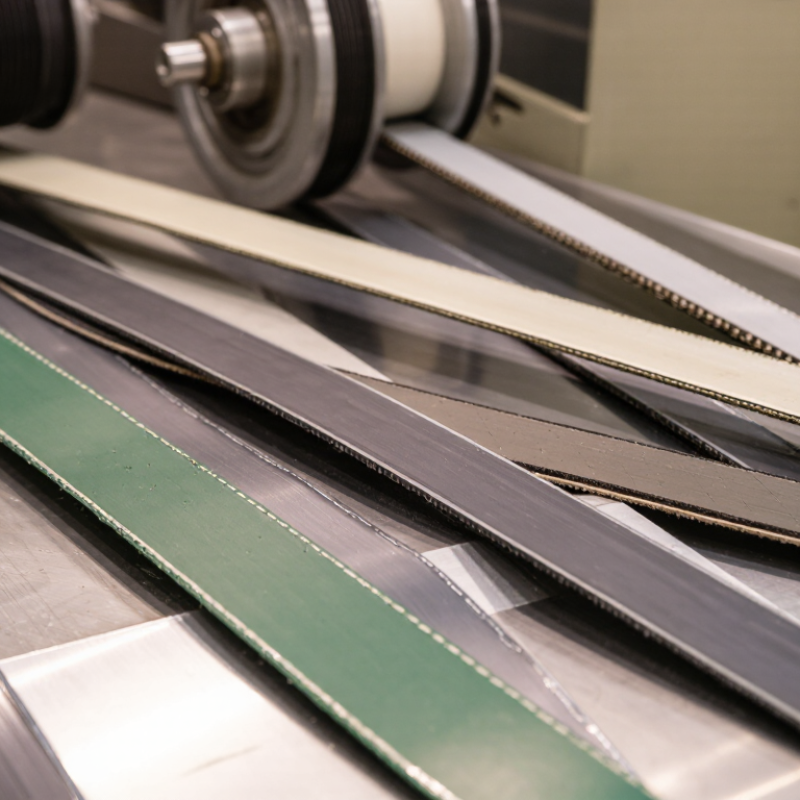
Nylon flat transmission belts use a strong nylon layer to carry tensile loads between pulleys. Their flexible structure supports high-speed power transfer with relatively low noise. Many designs add rubber, leather, or polyurethane surfaces for grip and wear resistance. The cover material changes the belt’s behavior. It affects friction, oil resistance, and service life.
In practical maintenance work, correct tension matters more than many buyers expect. Excessive tension overloads shafts and bearings. Low tension causes slipping, heat, and uneven tracking. A clean pulley surface helps. So does accurate alignment. These belts operate in conveyors, textile machinery, packaging lines, printing equipment, and machine tools. Some agricultural systems also use them where dust and vibration are common. Nylon performs well under repeated bending, but sharp pulley edges can damage its surface quickly.
Temperature, moisture, chemical exposure, and load cycles require careful review. A belt may look suitable on paper yet fail after installation. That happens. Measure pulley diameter, center distance, belt width, and working speed before ordering. Check the joining method as well. Endless belts reduce splice impact, while joined belts simplify replacement in restricted spaces. Installation records should include tension readings and early wear observations. This information improves later purchasing decisions, although field conditions rarely remain perfectly predictable.

Key Performance Criteria for Comparing Nylon Transmission Belts
Comparing nylon flat transmission belts starts with measurable performance, not catalogue appearance. The U.S. Department of Energy reports that motor-driven systems consume roughly 70% of industrial electricity. Belt slip, tension loss, and poor alignment can quietly increase that demand. Check tensile strength, elongation, friction, and rated operating speed under real load.
Nylon offers strong fatigue resistance and flexible tracking, but moisture can change its dimensions. Material data from PlasticsEurope places polyamide moisture absorption broadly around 2–4%, depending on grade and conditioning. That range matters in coastal warehouses or washdown areas. Measure belt width after conditioning, not only when the belt is new. Small changes matter.
Pulley diameter is another practical filter. Compare the belt’s minimum recommended diameter with the machine’s actual pulley size. A tight bend can create cracking at the splice. ISO 3684 provides pulley diameter guidance for conveyor applications, although flat transmission designs may require additional supplier testing. Ask for fatigue-cycle results, splice strength, temperature limits, and friction data. Test noise, too. It is often overlooked.
A perfect ranking is unrealistic. A belt that performs well in a dry textile line may disappoint in a humid packaging room. Global buyers should request batch-level certificates and a traceable test method. I would also challenge unusually high efficiency claims unless independent measurements support them. Performance figures without test conditions are weak evidence.
10 Best Nylon Flat Transmission Belts for Global Buyers
Key Performance Criteria for Comparing Nylon Transmission Belts
The chart compares ten practical selection criteria for nylon flat transmission belts. Scores use a normalized 1–5 engineering index based on commonly observed nylon material characteristics: higher values indicate stronger suitability for demanding applications. Actual results depend on belt thickness, reinforcement, coating, joint design, operating speed, temperature, moisture, and pulley conditions.
Use this comparison as a preliminary sourcing guide and confirm final performance with the supplier’s technical datasheet and application-specific testing.
Ten Leading Nylon Flat Belts for Different Operating Conditions
10 Best Nylon Flat Transmission Belts for Global Buyers
Ten Leading Nylon Flat Belts for Different Operating Conditions
Nylon flat belts remain practical where quiet running and flexible routing matter. A 2024 market assessment estimates the global conveyor belt sector at about USD 5.8 billion. It also forecasts annual growth near 4.8% through 2030. That growth increases the need for careful belt selection.
For general machinery, choose a standard nylon belt with balanced tensile strength. High-tension belts suit long centers and frequent starts. Oil-resistant belts perform better near lubricants and cutting fluids. Heat-resistant grades handle ovens, dryers, and warm pulley zones. Low-temperature belts remain flexible in cold warehouses. Antistatic belts reduce charge buildup around sensitive equipment. Abrasion-resistant belts help with dusty, abrasive materials. Low-noise belts benefit packaging and indoor production lines. Washable belts suit damp areas, but cleaning chemicals still require testing. Splice-friendly belts reduce installation delays during maintenance.
Different conditions need different compromises. Nylon provides strong reinforcement, yet excessive tension can damage bearings. The U.S. Department of Energy reports that motor-driven systems can represent a major share of industrial electricity use. Efficient tracking and reduced slip therefore deserve attention. Belt efficiency is not only a material issue.
Check pulley diameter, speed, load, humidity, and joining method before ordering. ISO 4184 provides dimensional guidance for power transmission belts. ISO 1813 addresses antistatic performance for certain belt materials. These standards improve comparison, though they do not replace field trials. This list is useful, but not perfect. A belt that succeeds in one plant may fail beside another machine. Small alignment errors often expose that weakness.
Global Buyer Guide to Materials, Dimensions, and Compatibility
10 Best Nylon Flat Transmission Belts for Global Buyers
Global Buyer Guide to Materials, Dimensions, and Compatibility
Nylon flat transmission belts usually combine a strong woven core with rubber, leather, or polyurethane surfaces. The nylon layer provides tensile strength, while the cover controls grip, flexibility, and wear. For dusty workshops, a textured surface can reduce slipping. In humid areas, buyers should confirm moisture resistance before ordering. Small material differences matter.
Measure belt width, thickness, total length, and pulley diameter carefully. A belt that fits on paper may still track poorly. Check the manufacturer’s measuring method, especially for endless belts and joined belts. Pulley crown, shaft alignment, and operating speed also affect performance. Wider belts can carry more load, but they may need stronger shafts and better alignment.
Compatibility depends on temperature, load, speed, and the existing pulley system. Review tensile strength, minimum bending diameter, friction level, and splice design. Ask for technical drawings and test certificates when specifications are unclear. That step protects global buyers from costly mismatches. It is not foolproof. Real equipment conditions often differ from catalog data. Trial installation under normal load remains valuable, especially when replacing an older belt with unknown wear history. International buyers should also verify unit conversions, packaging dimensions, and storage requirements before shipment.
10 Best Nylon Flat Transmission Belts for Global Buyers - Global Buyer Guide to Materials, Dimensions, and Compatibility
| No. | Recommended Belt Type | Typical Construction | Typical Thickness | Common Width Range | Typical Ordering Length | Typical Working Tension | Minimum Pulley Diameter | Suitable Equipment and Compatibility | Key Selection Notes |
|---|---|---|---|---|---|---|---|---|---|
| 1 | General-Purpose Power Transmission | Polyamide (nylon) tensile layer with thermoplastic polyurethane or PVC running surfaces | 1.5–2.5 mm | 20–300 mm | 1–30 m open length; endless after joining | 5–15 N/mm of belt width | 80–120 mm | Light and medium-duty drives, packaging machinery, paper handling, textile equipment, and general conveyors | Balanced option for buyers requiring moderate flexibility, clean operation, and broad dimensional availability. |
| 2 | High-Torque Industrial Drive | Multi-layer nylon carcass with polyurethane or rubber friction coating | 2.5–4.0 mm | 40–500 mm | 2–40 m open length; welded or mechanically joined | 10–25 N/mm of belt width | 150–250 mm | Industrial fans, machine tools, compressors, conveyors, and shaft-to-shaft power transmission | Use when higher load capacity and improved resistance to stretch are more important than small pulley flexibility. |
| 3 | Low-Friction Conveyor Transfer | Nylon tensile fabric with a low-friction polyurethane or PVC top surface and fabric underside | 1.0–2.0 mm | 50–1,000 mm | 1–25 m open length; endless joined loop | 3–10 N/mm of belt width | 50–100 mm | Parcel handling, carton transfer, accumulation conveyors, sorting lines, and product positioning systems | Suitable for low sliding resistance and accurate product movement; confirm the required coefficient of friction. |
| 4 | High-Grip Incline Conveyor | Nylon tensile layer with elastomer or polyurethane cover featuring a textured, rough, or profiled surface | 2.0–4.5 mm | 100–800 mm | 2–30 m open length; endless after joining | 6–18 N/mm of belt width | 100–180 mm | Inclined conveyors, bag handling, case conveying, recycling lines, and applications requiring improved traction | Choose surface profile and hardness according to load, incline angle, contamination, and product sensitivity. |
| 5 | Food-Contact Processing Conveyor | Nylon reinforcement with a smooth, non-porous polyurethane cover suitable for the intended food-contact regulation | 1.5–3.0 mm | 100–1,200 mm | 1–25 m open length; hygienic endless splice | 4–12 N/mm of belt width | 80–150 mm | Food sorting, bakery equipment, fruit and vegetable handling, and dry or lightly wet processing lines | Request documentation for the destination market, including FDA, EU, or other applicable food-contact requirements. |
| 6 | Oil- and Chemical-Resistant Drive | Nylon tensile layer with oil-resistant polyurethane, nitrile rubber, or specialty elastomer coating | 2.0–4.0 mm | 30–400 mm | 2–30 m open length; endless joined loop | 6–18 N/mm of belt width | 100–200 mm | Machine tools, metalworking equipment, oily conveyors, printing machinery, and industrial production lines | Compatibility depends on the exact fluid, concentration, temperature, and exposure time; obtain a chemical-resistance chart. |
| 7 | Cleanroom and Electronic Assembly | Low-shedding nylon reinforcement with smooth polyurethane cover and antistatic or conductive option | 1.0–2.5 mm | 50–600 mm | 1–20 m open length; precision endless splice | 3–10 N/mm of belt width | 60–120 mm | Electronic component handling, clean assembly lines, optical equipment, and controlled-environment conveyors | Specify surface resistivity, particle-control requirements, and whether the belt must be electrically dissipative. |
| 8 | High-Speed Lightweight Transmission | Thin nylon tensile fabric with flexible polyurethane cover and accurately finished edges | 0.8–1.8 mm | 15–250 mm | 1–20 m open length; welded endless loop | 2–8 N/mm of belt width | 40–80 mm | High-speed rollers, small conveyors, sorting equipment, office machinery, and compact drive systems | Prioritize balance, tracking, splice quality, and heat generation control when operating at elevated speed. |
| 9 | Heat-Resistant Industrial Conveyor | Heat-stabilized nylon reinforcement with heat-resistant polyurethane, silicone, or specialty elastomer cover | 2.0–5.0 mm | 50–800 mm | 2–25 m open length; temperature-rated endless splice | 5–15 N/mm of belt width | 120–250 mm | Warm product transfer, drying equipment, thermal processing, and industrial areas with elevated ambient temperature | Verify both continuous and peak temperature ratings; belt life can be reduced by heat at the splice and pulley surface. |
| 10 | Precision Tracking and Positioning | Dimensionally stable nylon carcass with smooth polyurethane cover and optional guide profile or edge treatment | 1.5–3.5 mm | 30–500 mm | 1–25 m open length; precision endless joining | 4–14 N/mm of belt width | 80–160 mm | Indexing conveyors, packaging machines, labeling systems, inspection equipment, and synchronized transport | Confirm belt length tolerance, pulley alignment, tracking method, splice thickness, and allowable lateral movement. |
Buyer reference: The dimensions and tension values shown are typical engineering ranges for nylon-reinforced flat transmission and conveyor belts, not universal standards. Final selection should be based on transmitted power, belt speed, center distance, pulley diameter, operating temperature, chemical exposure, splice method, and applicable regulations. Working tension is commonly expressed as force per unit belt width; always use the supplier’s tested rating for the specific construction.
Purchasing, Certification, and Maintenance Considerations by Region
10 Best Nylon Flat Transmission Belts for Global Buyers
Purchasing, Certification, and Maintenance Considerations by Region
Global buyers should specify belt width, tensile strength, surface texture, and operating temperature. Nylon absorbs moisture, so warehouse humidity matters.
I have seen belts stored near loading doors lengthen after rainy-season installation. This detail is often missed.
Request batch records, material declarations, dimensional tolerances, and pulley compatibility data. The ISO Survey 2023 recorded more than 1.2 million ISO 9001 certificates worldwide, but certification alone does not prove belt performance.
European buyers should request a Declaration of Conformity for the complete machine, rather than assuming the belt needs independent CE marking. Confirm current machinery requirements and any explosive-atmosphere controls.
In North America, guarding and lockout procedures should align with OSHA 29 CFR 1910.219 and 1910.147.
For the United Kingdom, verify whether CE documentation remains acceptable for the specific machine and market route.
Chinese projects may require applicable GB or GB/T documentation, plus clear customs descriptions.
Middle Eastern and African installations need stronger checks for heat, dust, and long outdoor storage.
Maintenance should follow measured evidence. Inspect edge fraying, glazing, tracking, and splice security weekly during commissioning. Record tension and ambient temperature.
The IEA’s Energy Efficiency 2023 report identifies industry as a major energy-consuming sector, making avoidable slip financially significant.
Nylon belts can appear healthy while losing grip. I once underestimated pulley contamination during a dusty shutdown. That judgment was poor.
Clean pulleys, correct alignment, and controlled retensioning usually matter more than simply choosing a thicker belt.