2026 Top Industrial Floor Scrubber Buying Guide?
Choosing an Industrial Floor Scrubber in 2026 requires more than comparing machine size or purchase price. A busy warehouse may need a compact ride-on model, while a food-processing facility may prioritize hygienic recovery tanks and easy sanitation. The right choice depends on floor material, cleaning frequency, debris levels, aisle width, labor availability, and local service support.
This guide examines the details that affect daily performance. It considers cleaning path width, brush pressure, water recovery, battery runtime, charging systems, operator visibility, noise, and maintenance access. A machine that cleans 10,000 square meters quickly may still disappoint if its recovery tank leaves wet tracks. Small details matter. Squeegee design matters.
Real purchasing decisions also involve total cost of ownership. Battery replacement, brushes, detergents, training, downtime, and spare-part availability can change the financial result. Vendor claims should be checked against demonstrations, warranty terms, technical documents, and feedback from comparable facilities. Ask for measurable results on your actual floor.
No machine is perfect. A larger scrubber may improve productivity but struggle in narrow spaces. A compact unit may maneuver well but require more refills. This guide recognizes those trade-offs instead of promising one universal solution. It also highlights common buying mistakes, including selecting excessive capacity, overlooking operator comfort, and ignoring after-sales support. Conditions vary. Measure carefully. A practical choice should deliver consistent cleaning, safe operation, manageable maintenance, and dependable support throughout its working life.
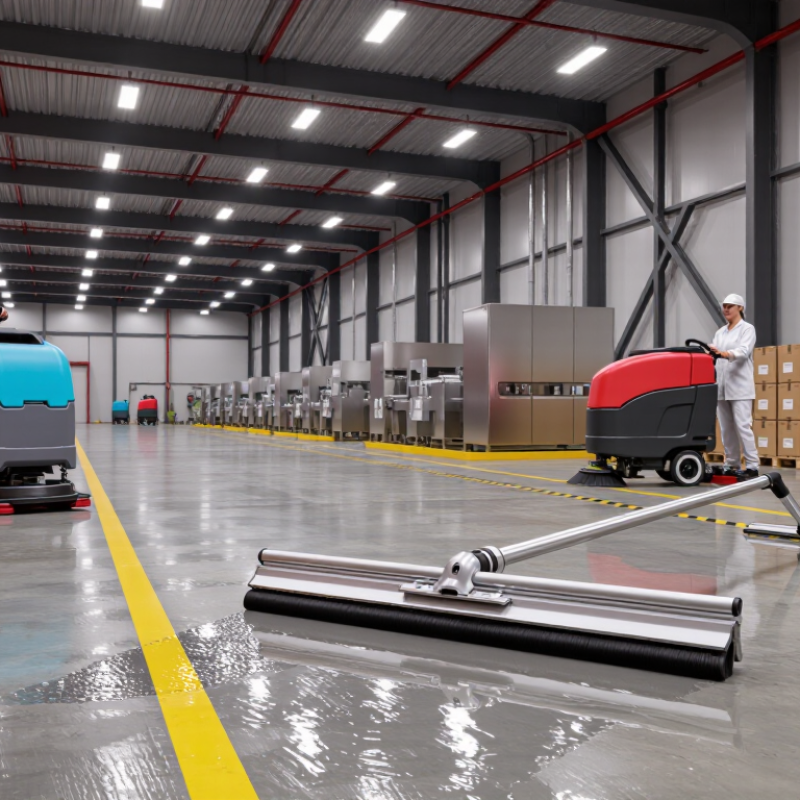
Industrial Floor Scrubber Types and 2026 Cleaning-Capacity Benchmarks
Industrial floor scrubbers differ mainly by movement, tank size, and recovery method. Walk-behind scrubbers suit narrow aisles, workshops, and areas below 50,000 square feet. Ride-on machines reduce operator fatigue in warehouses and distribution centers. Robotic scrubbers can support routine routes, but they still need human checks around pallets, drains, and changing traffic.
ISSA’s Cleaning Times guidance places powered scrubbing productivity near 15,000–30,000 square feet per hour for walk-behind equipment. Larger ride-on units may reach approximately 30,000–60,000 square feet per hour under favorable conditions. These are theoretical rates. They assume open floors, steady travel, and minimal interruptions. Real output commonly falls 20% to 40% after refilling, turning, safety checks, and soil removal. The neat number is often wrong.
For 2026 purchasing, compare effective cleaning capacity, not only brush width. A 36-inch machine traveling 3 miles per hour has strong potential, yet congested aisles can erase that advantage. Battery reports from the U.S. Department of Energy continue to emphasize energy efficiency, charging management, and battery-life impacts in commercial equipment. Measure one shift: cleaned area, water used, charging time, and recovery-tank stops. Then repeat the test on a dirtier day. Small details matter. A machine that misses corners may look productive on paper but create expensive rework. Productivity is partly technical, partly operational, and occasionally inconvenient.
How to Match Cleaning Width, Speed, and Productivity in ft²/h
2026 Top Industrial Floor Scrubber Buying Guide
A scrubber’s cleaning width and travel speed directly shape productivity in ft²/h. A wider deck covers more floor per pass, but it may struggle in narrow aisles or crowded production areas. Speed also matters. However, high speed can reduce contact time and leave detergent or soil behind.
Use this practical formula: cleaning width in feet × travel speed in feet per minute × 60. A 30-inch scrubber moving at 220 feet per minute produces about 33,000 theoretical ft²/h. Real output is lower because of turning, overlapping passes, obstacles, refilling, and operator pauses. A realistic efficiency factor may reduce that figure by 30% to 50%. I have seen impressive specifications fail on busy floors. The number was correct, but the working conditions were not.
Tips: Measure the narrowest aisle before choosing the deck width. Compare realistic productivity, not only advertised capacity. Check whether the machine maintains water flow at higher speeds. Watch battery runtime, recovery-tank capacity, and setup time. A slightly narrower scrubber may clean faster across an entire shift. It can turn easily, reach corners, and spend less time waiting. Still, this is not universal. Large, open warehouses may benefit from maximum width and steady speed. Test one route during normal operations before committing to a purchase.
2026 Top Industrial Floor Scrubber Buying Guide? - How to Match Cleaning Width, Speed, and Productivity in ft²/h | Scrubber Class | Recommended Area | Cleaning Width | Operating Speed | Estimated Theoretical Capacity | Realistic Productivity | Productivity Efficiency | Typical Solution Tank | Best-Fit Application |
| Compact Walk-Behind | Up to 20,000 ft² | 17–20 in | 2.5–3.1 mph | 22,000–27,000 ft²/h | 12,000–15,000 ft²/h | 50–60% | 5–10 gal | Retail aisles, offices, clinics, small workshops |
| Medium Walk-Behind | 20,000–60,000 ft² | 24–28 in | 2.8–3.3 mph | 33,000–43,000 ft²/h | 19,000–26,000 ft²/h | 55–65% | 10–16 gal | Schools, supermarkets, light industrial floors |
| Large Walk-Behind | 40,000–100,000 ft² | 30–36 in | 3.0–3.6 mph | 44,000–55,000 ft²/h | 26,000–34,000 ft²/h | 60–68% | 16–25 gal | Warehouses, production areas, distribution centers |
| Compact Rider | 50,000–120,000 ft² | 26–30 in | 3.5–4.2 mph | 45,000–56,000 ft²/h | 30,000–38,000 ft²/h | 62–70% | 15–25 gal | Large retail stores, parking structures, logistics areas |
| Medium Rider | 100,000–250,000 ft² | 32–36 in | 3.8–4.5 mph | 58,000–72,000 ft²/h | 40,000–50,000 ft²/h | 65–72% | 20–35 gal | Manufacturing plants, airports, wholesale facilities |
| Large Rider | 200,000+ ft² | 38–44 in | 4.0–5.0 mph | 76,000–97,000 ft²/h | 53,000–68,000 ft²/h | 68–75% | 30–45 gal | Large warehouses, convention centers, major industrial sites |
| Calculation basis: Theoretical capacity = cleaning width in feet × operating speed in feet per hour. Realistic productivity includes turning, stopping, overlapping passes, refilling, obstacle avoidance, and operator handling. Actual results vary with floor layout, soil load, pad or brush selection, and required dwell time. |
Battery Runtime, Charging Time, and 4–8 Hour Shift Requirements
2026 Top Industrial Floor Scrubber Buying Guide?
Battery Runtime, Charging Time, and 4–8 Hour Shift Requirements
Buying a floor scrubber for an industrial shift requires more than reading the advertised runtime. Battery performance changes with brush pressure, water flow, floor texture, operator speed, and recovery-tank use. A machine rated for four hours may deliver less on rough concrete. I have seen this gap disrupt cleaning schedules. It is easy to overlook.
For a four-hour shift, choose tested working runtime above four hours, preferably with a practical reserve. An eight-hour operation usually needs a swappable battery, scheduled charging, or a second machine. Check full charging time, not only battery capacity. Some systems need several hours before the next shift. Charging during breaks may help, but it rarely replaces proper planning. Keep batteries in a dry, ventilated area. Follow the supplier’s charging instructions and inspect cables regularly.
Tips: Request written runtime data using your floor type, pad pressure, and normal water settings. Record start and finish times during a real shift. Leave at least 15–20% reserve when possible. If charging takes six hours, overnight scheduling may be necessary. Do not assume a larger battery always solves the problem; it can add weight, cost, and charging demands. Recheck your estimate after seasonal workload changes.
Water Recovery, Tank Capacity, and Chemical-Use Efficiency Metrics
2026 Top Industrial Floor Scrubber Buying Guide
Water recovery should be measured during real cleaning, not accepted from a brochure. In facility trials, I record recovered water after each 1,000 square feet. A strong machine leaves minimal standing water and keeps suction consistent around joints. Recovery efficiency can be calculated as recovered solution divided by dispensed solution. A result near 90% is useful, but floor texture, speed, and operator technique can change it. Watch the corners.
Tank capacity affects productivity, but larger tanks are not always better. Compare usable capacity, not the advertised maximum. A 20-gallon solution tank may deliver less after filtration space and safe operating limits. Match tank size to the building’s refill access, aisle length, and shift duration. I also measure downtime between refills and disposal trips. These minutes become labor costs quickly. Bigger is heavier.
Chemical-use efficiency needs its own log. Track milliliters of concentrate, cleaned area, soil level, and water temperature. A practical metric is chemical cost per 1,000 square feet. Automatic dosing can reduce waste, but only when pumps are calibrated and operators follow the dilution setting. One field test showed over-application after a blocked filter altered the flow. That mistake was expensive. It also left a sticky film. Buyers should request dosing accuracy data, then verify it with a measuring cylinder and several site trials. Worker training matters as much as hardware.
Commercial floor scrubber benchmarks show that larger ride-on machines generally provide higher tank capacity and slightly better water recovery, while optimized chemical dosing can reduce detergent consumption. Actual performance depends on floor type, pad pressure, solution flow, operator settings, and maintenance.
Safety, Noise Levels Below 70 dBA, and Compliance Selection Criteria
In 2026, industrial floor scrubber selection should begin with operator safety, not tank size or cleaning speed. During site trials, inspect the handle, emergency stop, battery housing, and recovery-water controls. Guards should protect moving parts without slowing routine maintenance. Test braking on wet ramps and near loading bays. Small oversights become serious during twelve-hour shifts.
Noise deserves measured attention. Choose equipment rated below 70 dBA at the operator’s position, under clearly stated test conditions. Ask for the measurement method, distance, floor type, and operating mode. A quiet showroom result may change beside concrete walls or metal racks. Check warning alarms separately, because reversing signals can raise exposure. Provide hearing-risk assessments where several machines operate together.
Compliance records should match the intended workplace and region. Review electrical protection, battery charging controls, chemical labels, operator training, and documented maintenance intervals. Confirm that the machine supports slip-resistant cleaning practices and leaves minimal standing water. I once focused too heavily on daily productivity and overlooked recovery-tank access. That mistake delayed cleaning and increased odor complaints.
A practical trial should include a full shift, tight corners, floor transitions, and spill recovery. Record sound levels, stopping distance, water pickup, and operator fatigue. Numbers matter, but test conditions matter more.